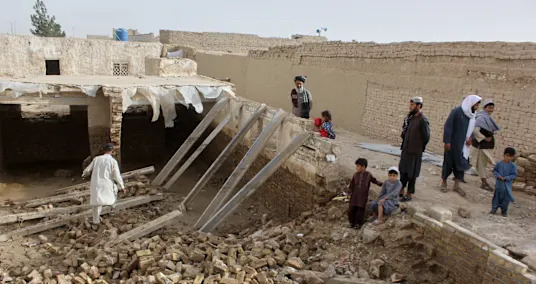
Heavy rain that has caused severe flooding and landslides has killed at least 45 people in Afghanistan and Pakistan over the past five days, authorities say.
Afghanistan’s National Disaster Management Authority (ANDMA) said on Monday that 28 people have been killed in the floods and 49 injured with more than 100 homes destroyed.
Most of the deaths in Afghanistan were reported in central and eastern provinces, including Parwan, Maidan Wardak, Daikundi and Logar, according to ANDMA.
The authority added in a statement that weather conditions remained “unstable” in parts of the country and there is a continued risk of more rain and flooding in some areas.
“In total, 1,140 families have been affected,” ANDMA said.
Police spokesperson Sediqullah Seddiqi told the AFP news agency a 14-year-old boy died after being struck by lightning in the northwestern province of Badghis.
He added that in the same province, three people had drowned while trying to gather driftwood to be used for heating.
At the same time in Pakistan’s Khyber Pakhtunkhwa province, which shares a border with Afghanistan, 17 people were killed and 56 wounded, the Provincial Disaster Management Authority said.

Extreme weather
Heavy rainfall has continued to sweep across Afghanistan since Thursday, causing floods and landslides in multiple provinces.
The weather prompted the closure of several highways, according to officials in central and eastern Afghanistan. Further rains and storms are forecast for Tuesday.
Afghanistan’s National Disaster Management Authority has warned citizens to refrain from using “rivers and flooded streams, and follow the weather forecast seriously”.
In the central province of Daikundi, the local disaster management department said a five-year-old was killed when a roof collapsed. A woman was also killed in the same circumstances in the eastern province of Nangarhar, police spokesperson Sayed Tayeb Hamad said.
Afghanistan is vulnerable to extreme weather, particularly heavy rainfall and monsoon seasons, which trigger floods and landslides in remote areas with fragile infrastructure.
In January, flash floods and snowfall caused the deaths of at least 17 people and killed livestock.
LATEST POSTS
- 1
 EPA watchdog finds nation’s most contaminated sites are vulnerable to flooding, wildfires
 - 2Pfizer says patient dies after receiving hemophilia drug in trial
- 3Some super-smart dogs can pick up new words just by eavesdropping
- 4Fiber is something most people could use more of. But experts advise caution with 'fibermaxxing'
- 5Administrative building in Sharjah region targeted by Iranian drone, UAE authorities announce



- My Dad Can't Travel Like He Used to, but Slowing Down Doesn't Mean Stopping
- Fossils from China show complex life evolved millions of years earlier than once thought
- Extraordinary Snowboarding Objections All over the Planet
- Doctors seek to understand why quitting antidepressants causes withdrawal for some
- How Mars 'punches above its weight' to influence Earth's climate
- AstraZeneca to acquire Modella AI to speed oncology drug research
- German inflation soars to 2.7% in March as Iran war drives up prices
- Former GLP-1 users regain lost weight after about 18 months, study says
- 'Zootopia 2' movie reviews: A heartwarming, hysterical and earnest 'ode to community'