When you buy through links on our articles, Future and its syndication partners may earn a commission.

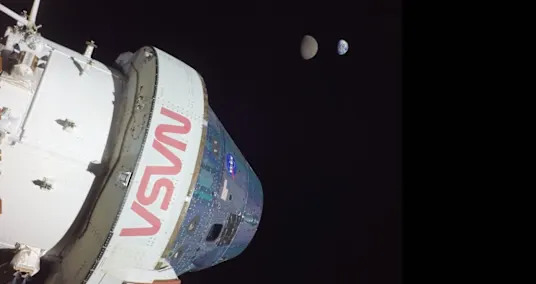
Once the Artemis 2 astronauts get beyond the protective environment of Earth's atmosphere and magnetic field, they will be subject to space radiation.
While en route to and from the moon, the four-person Artemis 2 crew will be vigilant, eyeing radiation detectors and listening for caution and warning alarms. They will also be outfitted with active dosimeters, devices that measure exposure to radiation, such as X-rays or gamma rays.
Artemis 2's Orion spacecraft is relatively highly shielded. However, the astronauts would still take defensive measures if they encountered particularly high radiation levels — from a powerful solar storm, for example. The astronauts would establish a shelter utilizing central stowage bays, whose contents would be moved to a known "hot spot" within Orion. Doing so would create a lower-dose region in the capsule, helping to reduce the crew's radiation exposure.
Radiation shielding
Artemis 2 will send NASA astronauts Reid Wiseman, Victor Glover and Christina Koch, and the Canadian Space Agency's Jeremy Hansen, on a roughly 10-day trip around the moon and back to Earth. NASA is targeting a launch as early as April 1.
As its name suggests, Artemis 2 will be the second mission of NASA's Artemis program. The first, Artemis 1, successfully sent an uncrewed Orion to lunar orbit and back in late 2022.
During Artemis 1, Orion spent more than 25 days in space and traveled a total of 1.4 million miles (2.25 million kilometers), gathering a wealth of valuable data about the deep-space environment and the capsule's performance within it.

"From the measurements on Artemis 1, we learned that the Orion is a good vehicle to be in during a radiation storm, as it is compact and dense and hence offers up good radiation shielding," said Stuart George, radiation instrumentation lead at NASA's Space Radiation Analysis Group (SRAG), based at Johnson Space Center in Houston.
"We learned that the Orion radiation storm shelter performs as expected and at different locations in the vehicle," George told Space.com.

Artemis 1 carried an instrument-laden manikin and two torso-only "body phantoms," which showed that doses to internal organs can be much lower than doses to skin during space weather events, said George.
The radiation exposure of the Artemis 2 crew will be gauged by Hybrid Electronic Radiation Assessors (HERA) and by small Crew Active Dosimeter badges that the crew will wear. There are six active HERA sensors deployed at various spots inside the Orion crew module.
Additionally, NASA has again partnered with the German Space Agency DLR, using an updated model of its M-42 sensor — an M-42 EXT — for Artemis 2. The new version — four of which will fly on Orion during Artemis 2 — offers six times more resolution to distinguish between different types of energy, compared to the Artemis 1 version.

Shelter in place
What about "go, no-go" decision-making for Artemis 2 in regards to dealing with a space weather or other space radiation event?
"Wile background galactic cosmic rays are difficult to shield from due to their high energies, solar particle events generated by the sun are a different matter," George said.
For solar particle events, NASA has predefined radiation dose rate levels after which the crew will work to construct a radiation shelter to reduce their exposure, said George.

If that dose rate threshold is exceeded, he added, the Artemis 2 crew would take material out from spacecraft storage bays and place those objects along the least shielded wall of the Orion capsule to build a radiation shelter.
"In addition, if an event is particularly bad, there are some places in the capsule, such as storage bays and down by the toilet, that the crew can go to," said George. Such areas would be pretty tight but would offer up even more shielding.
LATEST POSTS
- 1
 Beating Wellbeing Difficulties: Individual Victories in Health
 - 2Fossils from China show complex life evolved millions of years earlier than once thought
- 3San Francisco sues 10 companies that make ultraprocessed food
- 4New research reveals urban raccoons across the US show early signs of domestication
- 5A soft launch, an unfollow and a lot of questions: Breaking down the 'Summer House' romance blowing up group chats





- At least 171 measles cases confirmed in 9 states, CDC data shows
- What's Your #1 Pizza Beating Mix?
- Mexican Woman Accused of Assaulting Partner With Belt After He Refused Sex, Police Say
- Looking for under-the-radar adventures? Try Norway's Vesterålen
- From Squid Game to Your Party! Six Entertaining Test Games That Will Have You in Join
- Excursion to Different Universes: the Top Sci-fi Motion pictures Ever
- Israel's haredi draft crisis: Court ruling and political stalemate reach breaking point
- UN panel says Israel operating 'de facto policy of torture'
- Ghassan Al-Duhaini to replace Abu Shabab as Popular Forces leader in Gaza