When you buy through links on our articles, Future and its syndication partners may earn a commission.

HOUSTON — This may be the ultimate road trip on cruise control.
The four astronauts of NASA's Artemis 2 mission are now fully locked in to their trip around the moon after their Orion spacecraft aced a critical maneuver Thursday evening (April 2) to fling them into deep space. That engine burn, called a translunar injection, also committed the crew to return home, since Artemis 2 is flying on a loop around the moon that will bring it back to Earth. It's the first time since 1972 that astronauts have flown so far.
So what's an intrepid astronaut crew to do when you're cruising toward the moon, especially when it takes four days to get there, and another four days to get home? Well, perform CPR, for one.
Today is Flight Day 3 of the Artemis 2 crew's 10-day trip around the moon. It follows two intense days in space that began with a spectacular launch atop NASA's Space Launch System megarocket on April 1 (see amazing launch photos here), followed by a jam-packed 24 hours that included a close rendezvous with their rocket upper stage, manual tests of their Orion spacecraft, and critical engine burns to leave Earth behind. Now, the pace eases up.
"It's going to be much more relaxed than these first two days," Judd Freiling, NASA's Artemis 2 ascent flight director, told reporters here at the agency's Johnson Space Center late Thursday.
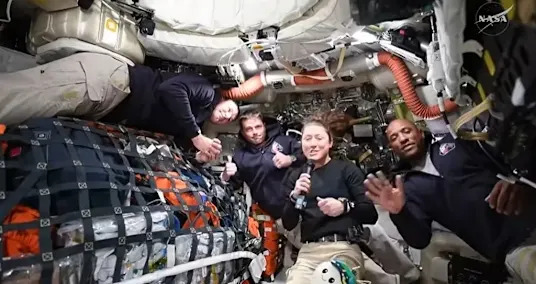
The Artemis 2 astronauts — commander Reid Wiseman, pilot Victor Glover (both of NASA), and mission specialists Christina Koch of NASA and Jeremy Hansen of Canada — will spend today rehearsing zero gravity life-saving techniques and gear in deep space.
"Glover, Koch, and Hansen will demonstrate CPR procedures in space; Wiseman and Glover will check out some of Orion's medical kit, including the thermometer, blood pressure monitor, stethoscope, and otoscope," NASA wrote in a mission overview.
The astronauts will also rehearse the complex choreography of photography and lunar observations that they hope to record when they fly closest to the moon in a flyby on Flight Day 6 of their mission, which will be April 6. They may even squeeze in time to look back at the Earth they've left behind. (See what the Artemis 2 crew is doing each day.)
"Observation certainly is one of those things that the crew absolutely will be doing during their time, and they've got plenty of time now to reflect and do those other operations," Frieling said. He added that Mission Control wants to make sure they have time to call their families on their trip. The crew hasn't had time yet to phone home.
The Artemis 2 astronauts have already completed a huge number of tests on their list so far for this Orion spacecraft shakedown cruise.

Glover manually flew the Orion spacecraft within about 50 feet (15 meters) of the SLS upper stage to test how the spacecraft's thrusters handle under manual control.
"I call it test driving the car," Howard Hu, NASA's Orion program manager, told reporters in Thursday's briefing. Orion seemed to perform just as expected during the trial, he added.
At one point, Glover was close enough to make out not just docking targets, but also an American Flag emblazoned on the rocket stage.
"I can see the side docking target. That is a good-looking American flag," Glover said.
"Overall, guys, this flies very nicely," he added at after completing the test. "Very precise."

On Thursday, Wiseman and Glover set up a new flywheel exercise device designed to test ways to stay fit on trips to the moon. After a half hour working out with the flywheel, which works like a zero-gravity rowing machine, Wiseman was impressed.
"Huge kudos, it works," Wiseman radioed to Mission Control. Aside from building up a slight static charge, the Artemis 2 commander said the flywheel was impressive. "Aside from that it is a really good piece of gear, and we can actually get a nice workout."

The astronauts spent some time storing at least 7 liters of water from their onboard tanks into plastic bags as a precaution after a valve got stuck during liftoff. Flight controllers wanted to make sure there was an available water supply if another valve had issues.
During the TLI burn preparations, the Artemis 2 reported some caution lights and a cabin leak alert, but all were benign and no threat, Hu said. They've also already repaired their Orion space toilet.
"We're learning about the boundaries of these caution and warning parameters, and whether they're really nuisances, or whether they're real issues," Hu said.
On Friday, Orion is scheduled to fire its thrusters to fine tune its path toward the moon. Koch is also due to test emergency communications systems using NASA's Deep Space Network. If all goes well, the astronauts may also participate in public affairs events.
"Things are going really well," Lori Glaze, NASA's acting associate administrator for exploration. "I think we couldn't be more pleased with how well things are going right now."
LATEST POSTS
- 1
 Mont Blanc road tunnel reopens to traffic after 15 weeks of repairs
 - 2Vote In favor of Your Favored Kind Of Organic product
- 3Christmas 2025 skywatching guide: What you can see in the night sky on Dec. 25
- 4Stunning new James Webb Space Telescope images reveal 'hidden' stars being born
- 5The Best Games On the planet




- The most effective method to Go Down Abundance through Ages with Disc Rates
- The Electric Toyota Hilux Is Finally here, But It's Not Cheap
- 2024 Ferrari Roma With Just One Owner & 3,300 Miles For Sale At $...
- 'The Golden Bachelor' Season 2 finale: How to watch tonight, start time, where to stream and more
- The best ice packs for coolers of 2026, tested and reviewed
- See the famous winged horse Pegasus fly in the autumn night sky
- Artemis II's moon-bound astronauts capture Earth's brilliant blue beauty as they leave it behind
- Figure out How to Adjust Work, Life, and an Internet based Degree
- The Advancement and Effect of Dental Embed Innovation on Oral Wellbeing