When you buy through links on our articles, Future and its syndication partners may earn a commission.

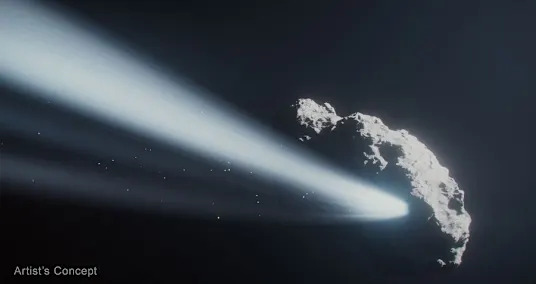
The Hubble Space Telescope has witnessed a spinning comet slow its own rotation and then start spinning in the opposite direction, in the first observation of its kind demonstrating that comets can be even more dynamic than we thought.
Comet 41P/Tuttle–Giacobini–Kresák is a Jupiter-family comet, meaning that it is a short-period comet (orbiting the sun every 5.4 years) that has come in from the Kuiper Belt before being snagged by Jupiter's gravity.
41P's last close approach to the sun — known as perihelion — was in September 2022, but it was the previous close approach in 2017 that was observed by the Hubble Space Telescope, as well as several other telescopes including NASA's space-based Neil Gehrels Swift Observatory and the four-meter (13 foot) Lowell Discovery Telescope in Arizona.
However, Hubble's observations weren't analyzed until David Jewitt, a planetary scientist at the University of California, Los Angeles, found the data in the Mikulski Archive for Space Telescopes, named after former U.S. Democratic senator Barbara Mikulski, who has been a staunch supporter of NASA.
Hubble's data, when combined with that of Swift and the Lowell Discovery Telescope, revealed something very odd about the comet. When Swift observed the comet in May 2017, it was spinning once every 46 to 60 hours, about three times slower than it had been in March 2017 when the Lowell Discovery Telescope observed it. That in itself was intriguing, but the Hubble observations deepened the intrigue as they showed that, by December 2017, the comet's spin had sped up again, and now had a period of about 14 hours. What had happened to reignite the comet's dizzying rotation?
Jewitt thinks that outgassing from the surface of the comet, which heated up during its perihelion passage that brings it about as close to the sun as Earth, is the cause. This heating prompted volatile gases close to the surface to expand and burst out in jets, carrying comet dust with them.
"Jets of gas streaming off the surface can act like small thrusters," said Jewitt in a statement. "If those jets are unevenly distributed, they can dramatically change how a comet, especially a small one, rotates."
The comet's nucleus is just 0.6 miles (1 kilometer) across, which is too small for even Hubble to resolve, but its speed of rotation can be measured from its light curve: How the light of the comet’s elongated nucleus changes as it rotates and alternates between showing us its longer and shorter sides. Because the comet's nucleus is fairly small, it leaves it susceptible to torques, or twisting forces, produced by the jets. However, it was not possible to infer the direction of that rotation, whether it was clockwise or counterclockwise, from the observations.
Jewitt was further able to infer that the rotation, regardless of which direction it was initially, had reversed. The jets countered the comet's initial rotation, which caused the initial slow-down seen between the Lowell Discovery and Swift observations. Those jets then continued working against the rotation and eventually reversed it and spun the comet up fast the other way, which explains Hubble's observations.
"It's like pushing a merry-go-round," said Jewitt. "If it’s turning in one direction, and then you push against that, you can slow it and reverse it."
It is uncommon to see a comet change so abruptly, and if we go back to Hubble's observations of the comet in 2001, we can see that its overall activity when at perihelion has decreased since then by approximately an order of magnitude. Perhaps repeated perihelions — the comet is thought to have been in its current orbit for about 1,500 years — might be beginning to exhaust its supply of volatile ices. Or, perhaps the dust liberated by the jets is falling back onto the comet, covering those ices in an insulating layer that prevents the ices from being heated by the sun and sublimating as quickly.
However, Jewitt is skeptical that 41P/Tuttle–Giacobini–Kresák will last much longer. If the changes in its spin proceed apace, then gradually it is going to render the comet unstable and the fast rotation will lead to centrifugal forces that spin the comet apart.
"I expect this nucleus will very quickly self-destruct," said Jewitt.
The findings were published on March 26 in The Astronomical Journal.
LATEST POSTS
- 1
 Plane Passenger Allegedly Includes ‘Bomb Threat’ in Hotspot Network Name, Forces Flight to Make Emergency Landing
 - 25 Family SUVs for 2024: Which One Accommodates Your Family's Needs\uff1f
- 3Sean Penn lights up, Kylie Jenner gets A-list approval and 7 other moments you didn’t see at the Golden Globes
- 4Make your choice for the music application with the most amicable connection point!
- 5Massive supernova explosion may have created a binary black hole


- Beating Scholastic Difficulties: Understudy Examples of overcoming adversity
- The best movies to watch this holiday season: Stream 'A Christmas Story Christmas,' revisit 'The Night Before' and discover 'The Baltimorons'
- The most effective method to Alter Your Savvy Bed for A definitive Rest Insight
- The Response to Independence from the rat race: Methodologies for Creating Financial momentum
- Manual for Instructive Application for Youngsters
- Eat Well, Live Well: An Extensive Manual for Smart dieting and Sustenance
- Advocacy groups react after Mattel introduces 1st Barbie doll with autism
- Partner of crime boss Steven Lyons arrested in Dubai
- 4 Famous Attractions at Disneyland