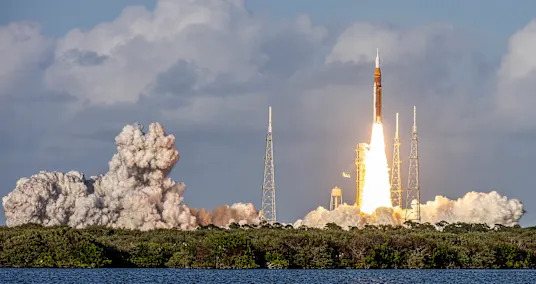
CAPE CANAVERAL, Fla. — NASA's first crewed moon mission in more than 50 years is underway.
NASA astronauts Reid Wiseman, Christina Koch and Victor Glover and Canadian astronaut Jeremy Hansen launched Wednesday evening on a 10-day journey to circle Earth and the moon.
“After a brief, 54-year intermission, NASA is back in the business of sending astronauts to the moon,” NASA Administrator Jared Isaacman said Wednesday at a post-launch news briefing.
The launch of the Artemis II mission was the first time that NASA’s Space Launch System rocket and Orion spacecraft carried human passengers into orbit.

The flight is intended as a step toward a planned moon landing in 2028.
An estimated 250,000 space fans flocked to central Florida to see the Artemis II mission lift off. Though a few minor issues cropped up during the countdown, they were resolved quickly, and the rocket made a stunning ascent through cloudless skies.
Now that the astronauts have reached space, they will have little downtime. For their first 8½ hours in orbit, the crew is tasked with testing out the Orion capsule’s various systems, including the potable water dispenser, the toilet and the air quality control system.
Another crucial test is to practice a docking procedure using the Space Launch System’s upper stage as a target. The technology demonstration will be crucial for future Artemis missions, during which astronauts will need to dock with a commercially built lunar lander before they travel down to the moon’s surface.
On Thursday, NASA will prepare for a major engine burn to send the Orion capsule toward the moon. Called the trans-lunar injection burn (TLI), the crucial maneuver is scheduled to take place roughly 24 hours into the mission. Flight controllers will meet earlier in the day to decide whether to proceed with the burn, which would put the astronauts on an irreversible path around the moon.
“We’re looking to make sure that the life-support systems work, the vehicle’s healthy,” Norm Knight, director of NASA’s Flight Operations Directorate, said after the launch. “Once we commit to TLI, they have to function.”

If all goes according to plan, the Artemis II astronauts will spend the following three days journeying to the moon.
Their next major milestone will come Monday, when they are scheduled to fly around the moon. When they do, they could venture farther from Earth than any humans have before, surpassing the distance record of 248,655 miles set by the Apollo 13 astronauts in 1970.
Over the course of the flyby, the Artemis II astronauts will come within 4,000 to 6,000 miles of the moon’s surface, according to NASA. From that vantage point, the moon should appear about the size of a basketball held at arm’s length.
As the astronauts swing around the moon, they will become the first to see parts of the lunar surface with human eyes. That is because the far side of the moon always faces away from Earth.
After the flyby, the astronauts will spend the final few days of the mission traveling back to Earth. They are scheduled to splash down in the Pacific Ocean off San Diego on April 10.
Artemis II is a key part of NASA's efforts to return astronauts to the moon and establish a long-term presence on the lunar surface. The agency eventually hopes to build a base on the moon.

Next year, NASA aims to launch the Artemis III mission, which will conduct technology demonstrations in low-Earth orbit with the commercially built moon landers. SpaceX and Blue Origin are developing landers to carry NASA astronauts from lunar orbit down to the moon's surface, so the mission could test one or both.
Then, NASA aims to launch the Artemis IV mission sometime in 2028 to land on the moon.
This article was originally published on NBCNews.com
LATEST POSTS
- 1
 Find Unexpected, yet invaluable treasure Excursion Rentals
 - 2Seven deaths possibly linked to malfunctioning glucose monitors
- 3Why some African countries are prone to military takeovers
- 4Dinosaur collagen used to create one-of-a-kind handbag
- 5Share your pick for the riding area that characterizes your surf undertakings!




- Gunmen open fire near Israeli consulate in Istanbul in possible ISIS-linked attack
- Cyber Monday 2025 streaming deal: Get $42 off six months of Apple TV
- The Craft of Do-It-Yourself Home Stylistic layout: Change Your Space
- Woman charged in unprovoked stabbing of tourist changing baby's diaper in Macy’s Herald Square store
- Big majority in Germany call Berlin's efforts on gas prices too weak
- The Electric Bicycle Americans Can Confide in 2024
- The year's first meteor shower and supermoon clash in January skies
- Evaluated Smartwatches for Wellness Devotees
- 7 Moves toward a Sound and Dynamic Way of life